From Acorn to Oak: A Dispatch from the Indigenous Advisory Board for Restoring Native Voice at the University of Michigan-Dearborn
Inclusive History Project
The fifth installment in our series of IHP Dispatches is written by the Indigenous Advisory Board for Restoring Native Voice at the University of Michigan-Dearborn, a two-year project managed by Principal Investigators Dr. Martin Hershock and Dr. Jacob Napieralski and funded by an IHP Research & Engagement Fund grant. The project aims to reimagine UM-Dearborn’s Environmental Interpretive Center (EIC) and campus natural area through formally recognizing the contributions of Indigenous peoples to the Dearborn campus and broader community and highlighting Indigenous perspectives in the work done at the EIC. The board shares the story behind the project and the guidance, presence, and stewardship that made project activities possible, such as the planting of a Three Sisters garden and the mural From Acorn to Oak painted by Indigenous artist Jamie John at the EIC.
From Acorn to Oak: A Dispatch from the Indigenous Advisory Board, for Restoring Native Voice at the University of Michigan-Dearborn
By: Dr. Ariel Roddy (Ojibwe), Assistant Professor, Northern Arizona University; Shiloh Maples (Little River Band of Ottawa), seed keeper, community organizer, and PhD student, University of Michigan; Cheyenne Travioli (Lakota), PhD candidate, University of Michigan; Gabrielle May (Anishinaabe descent), PhD student, University of Michigan; Dr. Juliette Roddy (Ojibwe), Professor and Wurgler Chair, Northern Arizona University
The Ojibwe sing, dance, and pray to Giche Manidoo for health and prosperity in this life, a bountiful harvest, a successful school year or career, or to express their respect and gratitude to the sources of life.
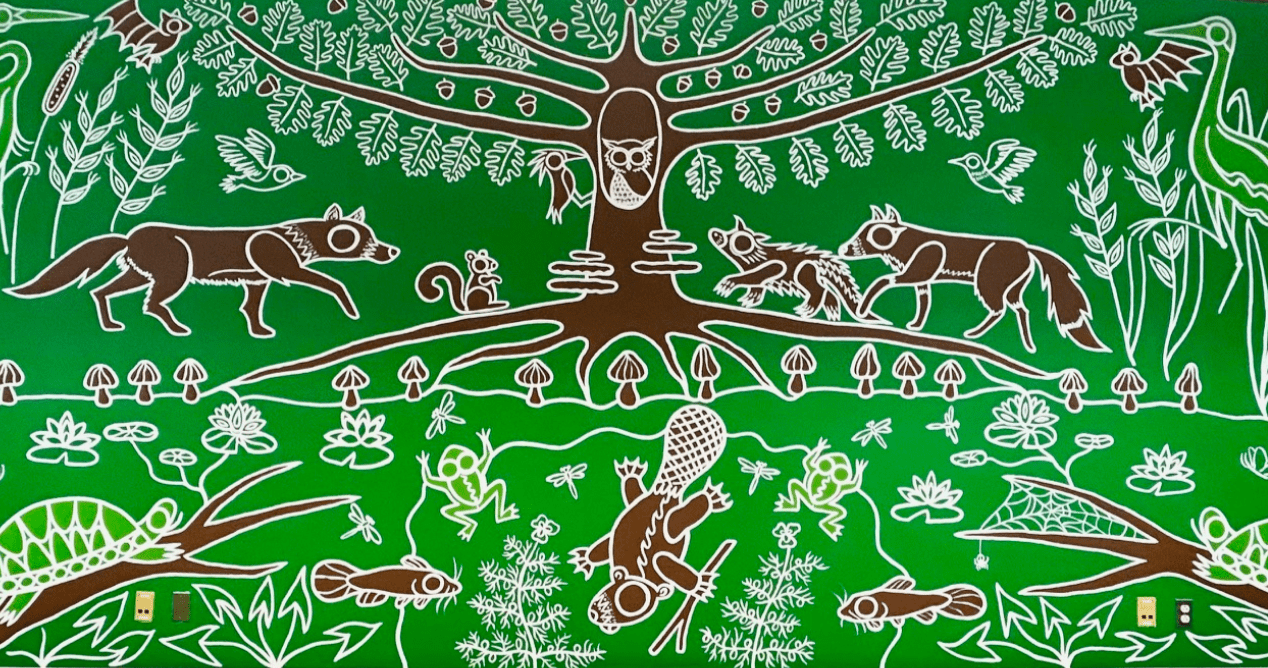
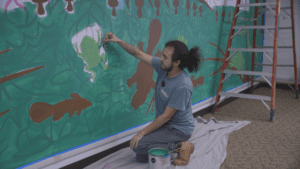
The mural From Acorn to Oak, painted by Jamie John, tells an Anishinaabe origin story. It reminds us that even the mightiest beings begin small, that strength is earned through patience, and that growth is never solitary. The acorn does not become an oak on its own. It depends on water, soil, wind, time, and the care of those who understand what it is meant to become.
That mural now lives inside the Environmental Interpretive Center at the University of Michigan-Dearborn. Visitors see it first—bold, alive, watching. What they may not immediately see is the quieter story behind it: the work of stewardship that began long before paint touched the wall. This Dispatch is offered by the Indigenous Advisory Board for Dr. Martin Hershock and Dr. Jacob Napieralski’s project funded by the Inclusive History Project. This board guided the work, integrating the teachings passed to us from our elders and ancestors.
Every story must begin with where it stands. Ours began with the land. Before gardens were planted or art was commissioned, we helped the university construct a land acknowledgment to ground and center the mission of the university in the historical context of the region.
From the words included in the land acknowledgment, we moved to soil. We brought seeds of the Three Sisters (corn, beans, squash) as carriers of memory older than the university itself. We planted them knowing that seeds are relatives. They hold stories of survival, of reciprocity, of nations who learned long ago that nothing thrives alone. We sang to, prayed for, and tended to them, and installed informational signage to teach the community about their origins and cultural significance. Students came to the gardens and to classrooms. We spoke with them there, sharing stories that braided land, history, and responsibility together.
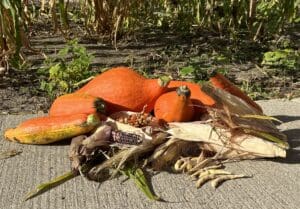
Corn, beans, and squash from the Three Sisters garden at the Environmental Interpretive Center.
As the gardens grew, our attention turned to the Environmental Interpretive Center itself. In Anishinaabe understanding, spaces remember. Before new stories can live within them, those spaces must be made ready. We invited Adon Vazquez of American Indian Health and Family Services to smudge and bless the building, moving smoke through its rooms to clear what lingered and to welcome what was coming. After this, the space was ready to accept the mural.
Through our relationships, we connected the project to Jamie John, an Indigenous artist whose work carries Anishinaabe origin stories forward with care. Their mural speaks of water as life, of beings bound together in responsibility, and of sovereignty that persists even when institutions forget.
Artist Jamie John painting the From Acorn to Oak mural.
As the mural grew more visible, a familiar tension surfaced. Indigenous people know this moment well. The work is celebrated. The presence that made it possible begins to blur. Our contributions were sometimes referenced, sometimes generalized, often unnamed. For a project committed to addressing Indigenous erasure, this absence carried weight. Indigenous people do not enter collaborations like this lightly. History teaches us caution. Cooperation with non-Indigenous institutions has often required assimilation, compromise, or silence. At times, participation feels like risk layered upon risk.
The Indigenous Advisory Board—Ariel Roddy (Ojibwe), Shiloh Maples (Little River Band of Ottawa), Cheyenne Travioli (Lakota), Gabrielle May (Anishinaabe descent), and Juliette Roddy (Ojibwe)—met with the university investigators month after month to guide this work. We carried knowledge, relationships, and responsibility into every stage of the project. We were compensated for our labor, which matters. But visibility matters too, because naming who does the work teaches institutions how to do better work in the future.
We are encouraged that our names will be placed alongside the mural, restoring presence where it belongs. It teaches those who come next that Indigenous knowledge is carried by people rather than “boards” in the abstract. The acknowledgement names our tribes and nations, properly recognizing the investment in their people and their role in preserving our histories and futures.
This Dispatch is the final act of stewardship in this cycle. Storytelling shapes what grows next.
Like the acorn, this project began quietly—with words, seeds, and trust. What it becomes will depend on how carefully it continues to be tended. We offer this story with love and responsibility, for those who will walk this campus long after us, and for the land that remembers all of us.
Top image: The completed From Acorn to Oak mural by Jamie John at the Environmental Interpretive Center.
All images courtesy of Martin Hershock and Rick Morrone.